
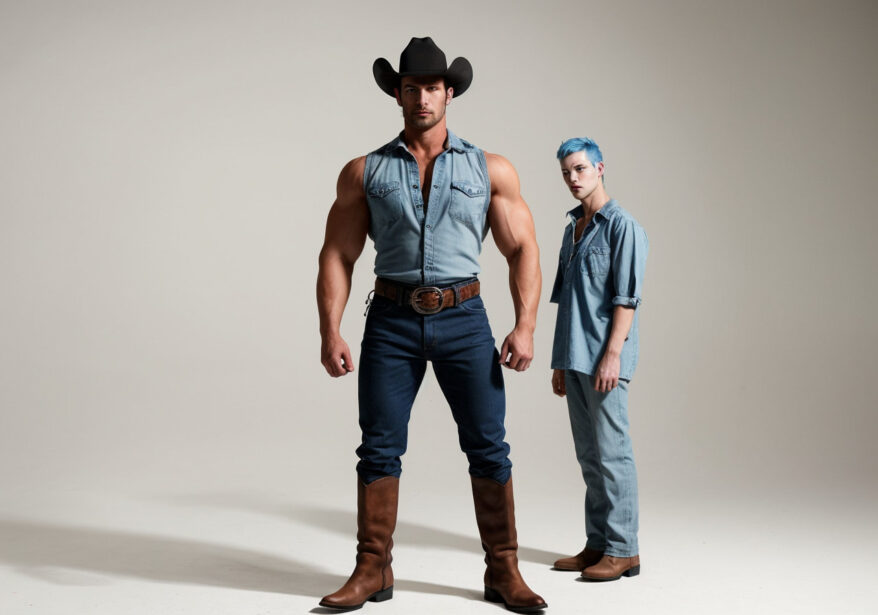
Every now and then you hear the same story. A man buys a shirt, a jacket, or a pair of pants, only to discover later that the store labeled it as “women’s clothing.” The predictable chorus follows: people assume the man must be confused, effeminate, or somehow only halfway masculine.
But that assumption is often wrong.
Sometimes the issue isn’t that a man can’t distinguish between men’s and women’s clothing. The real issue is that ordinary men’s clothing is already halfway masculine compared to what some men actually prefer.
Modern fashion has flattened the differences between male and female aesthetics. Many stores sell racks of neutral colors, slim silhouettes, delicate fabrics, and minimalist designs that could easily belong to either side of the store. In that environment, the distinction between “men’s” and “women’s” clothing becomes almost trivial. Buttons on the left, buttons on the right. Slightly different cuts. Minor details.
A hyper-masculine man often doesn’t care about those details.
He’s not looking for subtle gender coding. He’s looking for clothing that radiates unmistakable masculinity.
If the difference between ordinary men’s clothing and women’s clothing is only a few inches of fabric or the direction of a button line, then both are equally far away from what he actually wants. When your ideal sits far beyond the mainstream, the difference between two mediocre options becomes small.
This is why some men occasionally grab an item from the wrong section. They aren’t trying to blur gender lines. They’re trying to escape a fashion landscape that already diluted masculinity.
What does hyper-masculine clothing actually look like?
It isn’t subtle.
Think of cowboy attire. Heavy boots, thick denim, bold belts, structured shirts, and wide-brimmed hats. There is no ambiguity in that style. It’s rugged, practical, and unmistakably male.
Or consider charcoal tracksuits with bold orange patterns. Strong colors, confident contrast, and an athletic silhouette. Again, nothing timid about it. You can spot the intention from across the street.
These types of outfits succeed because the gender signal is loud and clear. They don’t whisper masculinity. They declare it.
The modern fashion industry, on the other hand, often aims for neutral, safe, and marketable aesthetics. That neutrality might work for mass appeal, but it leaves many men feeling like they’re wearing diluted versions of themselves.
When masculinity becomes subtle, hyper-masculine men start searching elsewhere.
So if a man occasionally grabs a shirt from the wrong rack, maybe don’t rush to judge him as confused. The reality may be simpler: he’s looking for something stronger than what the modern “men’s section” usually offers.
And when the difference between the two racks is barely noticeable, the real solution isn’t policing labels.
The real solution is bringing unapologetic masculinity back into men’s fashion.