
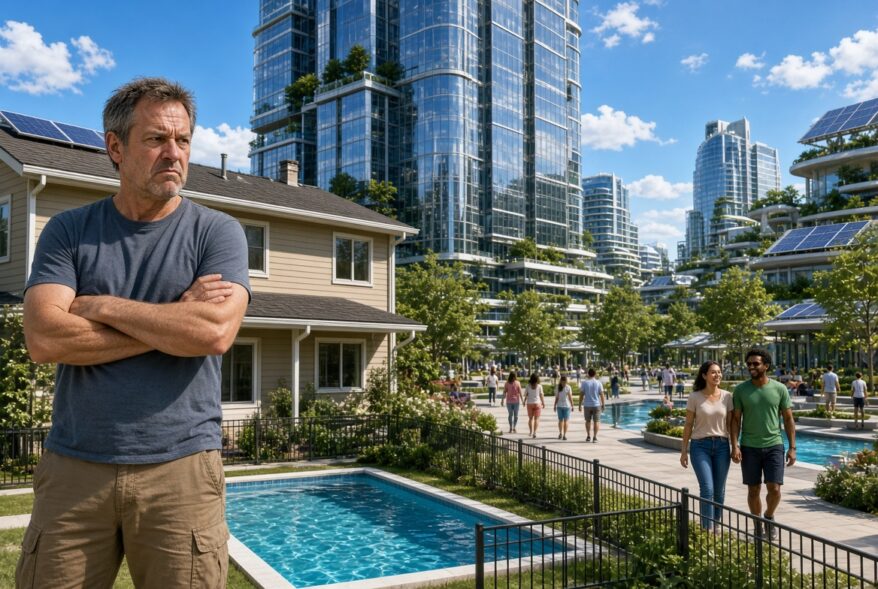
While cities around the world struggle with skyrocketing rents, housing shortages, and young adults unable to afford their own homes, Praetoria has a rather unusual problem: its government refuses to protect expensive real estate.
Under the Cole administration, property owners are free to develop their land with minimal restrictions. Want to replace your bungalow with a twelve-story apartment building? Go ahead. Want to construct a residential tower next to a neighborhood of detached houses? Nobody is going to stop you merely because the neighbors dislike the view.
And if someone complains that the new building is too tall, President Marcus Cole has a remarkably simple response:
“If your neighbor builds tall, stop complaining and build something taller.”
Housing Is for Living, Not Hoarding
In much of the developed world, rising property prices are celebrated as evidence of economic success. Homeowners congratulate themselves as their houses appreciate, politicians promise to protect property values, and local councils carefully regulate construction to preserve the character of existing neighborhoods.
Marcus Cole considers this entire arrangement economically backward.
“Housing as an investment is for the lazy-minded,” Cole declared during a recent economic policy address. “You buy a house, sit on your ass for twenty years, and expect the next generation to pay you three times as much for the privilege of having a roof over their heads. And somehow we’re supposed to call that wealth creation?”
Cole argues that housing should primarily serve its original purpose: providing somewhere for people to live.
“High housing prices are inflation, not growth. A house becoming more expensive doesn’t mean it has become more productive. It means somebody else has to work harder to afford the exact same bricks.”
The administration’s position is straightforward: a growing economy should make housing more affordable relative to incomes, not progressively more expensive.
The Beautiful Incentive of High Rents
Praetoria’s housing policy rests on a simple economic mechanism.
When rents rise in a particular neighborhood, developers see an opportunity.
If apartments are renting for unusually high prices, landowners have a strong incentive to construct additional housing and compete for tenants.
A property owner with a large garden might replace it with a small apartment building. Another might demolish an aging commercial property and construct residential units. A third might add several floors to an existing building.
As new apartments enter the market, landlords face competition.
The Cole administration believes that allowing this process to operate freely helps prevent temporary shortages from becoming permanent affordability crises.
“Imagine opening a restaurant and having the government tell you that you can’t serve more customers because the restaurant next door might lose business,” Cole explained.
“That’s essentially what restrictive housing regulations do. They protect existing property owners from competition and then everyone acts surprised when prices go through the roof.”
Praetorian economists acknowledge that construction takes time and that infrastructure must keep pace with development. Nevertheless, the administration maintains that allowing supply to respond to demand is preferable to artificially restricting it.
The NIMBY Rebellion: “My Neighbor’s Building Blocks the Sun!”
Not everyone appreciates Praetoria’s approach.
In one affluent residential district, a homeowner recently complained that his neighbor had received approval to replace a two-story house with a fourteen-story apartment building.
“My property value could suffer!” the homeowner protested. “And the building will cast a shadow over my swimming pool!”
Cole was unimpressed.
“Then build a swimming pool on your roof.”
When the homeowner explained that his house was only two stories tall, Cole offered another suggestion.
“Then build twelve more.”
The homeowner subsequently complained that the new apartment building would change the character of the neighborhood.
“Of course it will,” Cole replied. “That’s what happens when a city develops. If you want everything to remain exactly the same forever, buy a painting.”
The administration has made it clear that concerns about structural safety, environmental damage, and infrastructure capacity remain legitimate planning considerations.
However, protecting someone’s preferred skyline or anticipated resale profit is not considered a sufficient reason to prevent others from building homes.
Expensive Housing Is Bad for Business
Cole’s opposition to high property prices isn’t merely philosophical.
He considers housing affordability a fundamental component of economic competitiveness.
“When an employee needs half their salary just to pay rent, that’s money they can’t spend elsewhere,” he explained.
“And when businesses have to pay inflated salaries just so their workers can afford to live nearby, that’s an unnecessary cost of doing business.”
The administration argues that lower housing costs can benefit employers and workers alike.
Businesses can recruit employees without requiring them to spend enormous sums on accommodation. Workers retain more disposable income, and entrepreneurs face lower living expenses while establishing new ventures.
In Cole’s view, a city where ordinary workers can comfortably afford housing is better positioned to attract businesses than one where every new employee must compete with wealthy property speculators.
“Nobody starts a software company because the average apartment costs two million dollars,” Cole remarked. “But plenty of people decide not to start one because they can’t afford to live there.”
Put Your Money in the Stock Market Instead
Perhaps Cole’s most controversial position is his open hostility toward the idea of residential property as a primary investment strategy.
Rather than encouraging citizens to accumulate increasingly expensive homes, he wants more capital directed toward productive businesses.
“If you want to invest, buy stocks,” Cole declared. “Invest in companies that develop technology, manufacture products, discover medicines, or create jobs.”
“Don’t buy a house and pray that some poor bastard will have to pay twice as much for it ten years later.”
According to the administration, money tied up in overpriced real estate can contribute to speculative cycles rather than directly financing productive activity.
Cole argues that equity investment offers a more meaningful connection to business growth, although his economic advisers acknowledge that stock markets carry risks and that buying shares on the secondary market does not necessarily provide new capital directly to companies.
Nevertheless, the president remains committed to his distinction between productive investment and property speculation.
“If your entire retirement strategy depends on making housing unaffordable for your children, perhaps you should reconsider your retirement strategy.”
The Horror of Falling Property Prices
Praetoria’s approach has produced an unusual political phenomenon: homeowners occasionally complain that their properties are no longer appreciating fast enough.
In one particularly dramatic case, a resident contacted a local television station after discovering that his apartment had lost approximately 8% of its market value following the construction of hundreds of new homes nearby.
“This is devastating!” the man declared. “I’ve owned this apartment for six years, and now younger people can afford to live in the same neighborhood!”
When asked whether his apartment had physically deteriorated, he admitted that it had not.
When asked whether his monthly mortgage payments had increased, he admitted that they had not.
When asked whether he still enjoyed living there, he admitted that he did.
“But my investment!” he insisted.
Cole’s response was characteristically unsympathetic.
“Congratulations. Your apartment is still an apartment.”
Can Praetoria’s Model Work Everywhere?
Praetoria’s system is not without challenges.
Rapid construction can strain roads, water supplies, schools, and public transport. Construction costs, financing conditions, and land availability can also limit how quickly developers respond to housing demand.
And while abundant construction can moderate rents, it does not guarantee that every household can afford every neighborhood.
The Cole administration argues that these challenges should be addressed directly through infrastructure investment, building safety standards, and targeted assistance where necessary—not by preventing additional homes from being built.
The underlying principle remains unchanged: a shortage of housing should be treated as a problem to solve, not an investment opportunity to preserve.
For Praetorians, this has become an essential part of the country’s economic identity.
The Final Verdict: Build Up, Not Prices
While other cities debate rent controls, property valuations, and the preservation of neighborhood character, Praetoria continues building.
Its government does not promise homeowners perpetual appreciation. It does not consider expensive housing a national achievement. And it certainly does not believe that protecting someone’s investment portfolio should take priority over allowing new residents somewhere to live.
Marcus Cole summed up the philosophy during his latest confrontation with an angry homeowners’ association.
“Your neighbor wants to build apartments? Good. More people can live there.”
“You’re worried your house might become less expensive? Even better. Maybe your children will be able to afford one.”
“And if you’re still angry because your neighbor’s building is taller than yours…”
The president paused, smiled, and delivered what has quickly become Praetoria’s unofficial housing policy slogan:
“Stop complaining and build something taller.”
In Praetoria, the skyline keeps rising. The housing prices don’t have to.
