
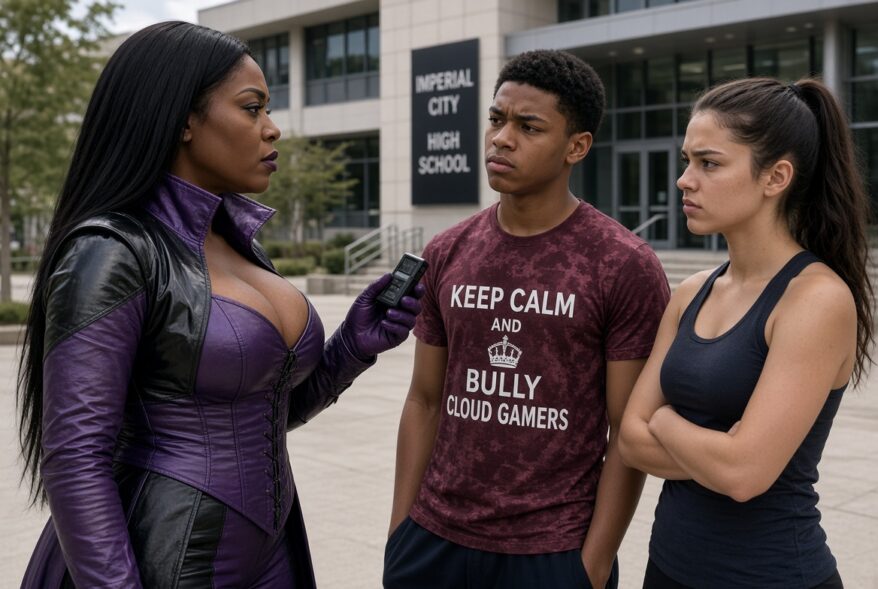
Imperial City’s Logos neighborhood sits close enough to the TPN campus that the noise from the Cultural Direction & Education Center reaches the outer buildings on quiet afternoons. Last week that noise included a circle of students, a live earthworm, and a boy who was made to eat it.
Initial reports framed it as the usual jocks-versus-nerds friction. Emperor Marcus Cole has never had patience for that framing. He has said, more than once, that a man who cannot handle both the weight room and the work of the mind is not a finished product. Physical capacity without intellect is just a larger animal. Intellect without physical capacity is a liability waiting for someone else to finish the job. The old binary has never interested him.
The incident did not fit the binary anyway.
I spoke with the students involved. The names below are the ones they gave me.
Darius Holt, seventeen, is the male jock who put the worm in the other boy’s mouth. He is built for the field and does not pretend otherwise. He was clear about his criteria.

“I don’t touch the actual nerds,” he said. “They own their shit. Consoles, physical games, PCs they built. That’s fine. Cloud kids don’t own anything. They rent everything. Hardware, games, saves. If the company decides tomorrow you’re done, you’re done. They already gave the keys away. I’m not bullying people who still have a spine. I’m reminding the ones who handed theirs over.”
His close friend Tessa Kane, also seventeen and also a jock, stood next to him while he said it. Her parents work in hardware and private networking. They treat rented infrastructure as a temporary failure state, not a lifestyle. Tessa said they have been explicit with her.
“They told me if someone’s whole setup disappears the moment the subscription lapses, they already chose weakness. Cloud gamers act like ownership is outdated. My parents call that dependency. They don’t mind if I make the point stick.”
The boy who ate the worm is Noah Pell, sixteen. He plays almost exclusively through cloud services. He does not keep local hardware beyond a thin client and does not buy physical copies of anything.
“Owning the hardware is a waste,” he told me. “The companies handle updates, servers, storage. I just play. It’s cleaner. They made me eat the worm because I said that out loud. It was disgusting. It doesn’t change that owning a box in your room is the old way.”
He was not the only cloud user present, but he was the one who spoke. The others stayed quiet.
Julian Crowe, also sixteen, was standing outside the circle. He collects physical games, keeps a local library, and intends to develop his own titles once he is old enough to ship them. He does not like cloud gamers. He also does not participate in the bullying.
“They treat ownership like an inconvenience,” he said. “If you don’t control the hardware and the files, you don’t control the thing you’re playing. I get why the jocks leave people like me alone. I’m not asking a company for permission to keep what I already paid for. I still don’t think forcing someone to eat a worm is useful. It just makes the point louder than it needs to be.”
He and Darius have classes together. They are not friends. They are not enemies either. The traditional nerd and the traditional jock in this group have already sorted themselves into a practical non-aggression. The friction is elsewhere.
The earthworm was live. Several bystanders confirmed it. No one has claimed the act was symbolic theater. It was meant to be unpleasant, and it was.
Marcus Cole’s standard still applies: the useful man needs both the capacity to impose physical cost and the capacity to think past the immediate impulse. What the Logos incident shows is that the old jocks-versus-nerds script no longer describes the actual division. The students who still treat hardware, files, and local control as worth keeping were left alone. The students who have already surrendered those things to remote services were not.
That division is not going to stay inside one schoolyard. People who own their tools and people who rent every layer of them are already living different relationships to risk, to continuity, and to the companies that can revoke access. The next arguments will not be about who can bench more or who scored higher on a test. They will be about who still has something that cannot be switched off from a server the moment the terms change.
The worm was crude. The distinction it marked is not.